
7. Decoding HBR’s Latest Article on Why Innovation ‘Fails to Scale’
Are we expecting a different outcome here?

The article’s prescription for scaling innovation is to develop “bridgers” with desirable behaviors:
curate partners,
translate between them,
integrate disparate intentions,
develop EQ, and
know the context.
The premise - if you don’t have bridgers, your innovations won’t scale.
Cool. At least that’s what I thought the first time I read it, 20 years ago.
Look at this list.
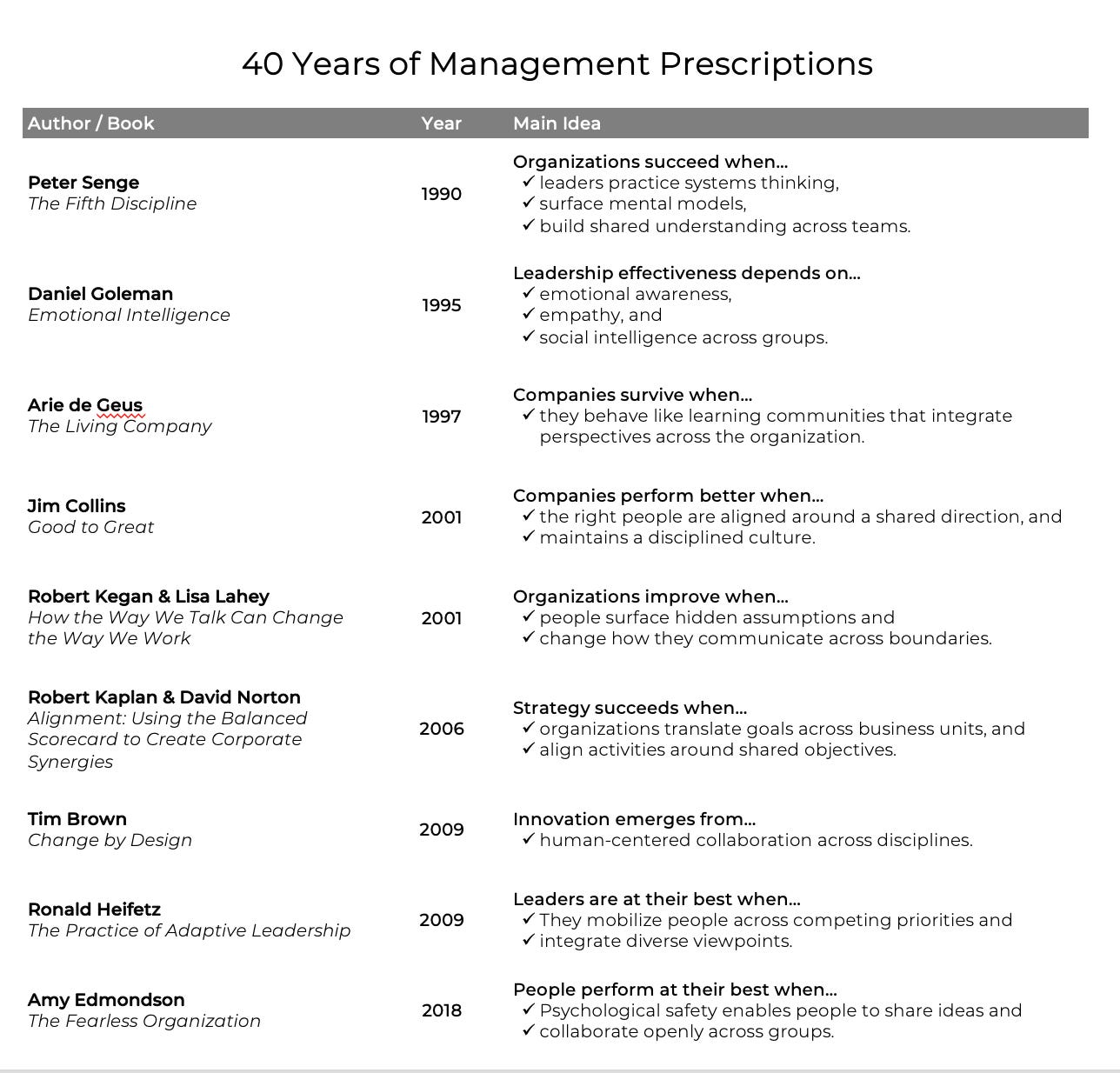
40-YEAR SUMMARY: align people, use EQ, build trust, translate across groups, surface assumptions, understand context, collaborate across silos.
What’s the pattern?
Why are we talking about the same “best practices” as if they’re new?
Why are we talking about the same prescriptions as if they will work this time around?
The questions aren’t to criticize the authors,
but to provoke us all.
why aren’t we integrating best practices?
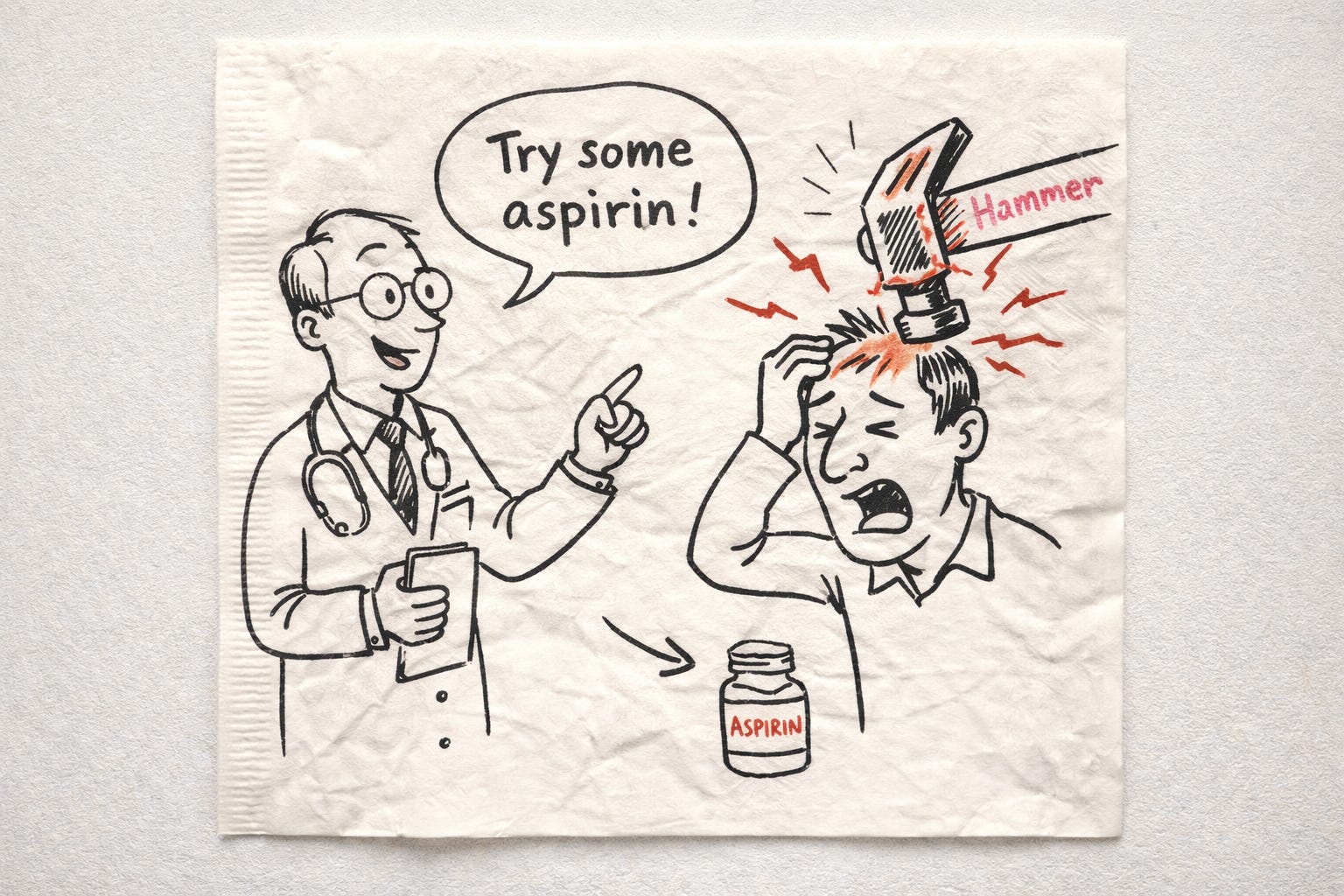
You can take aspirin for the headache, but if you don’t stop the hammer causing it, the pain will persist.
I met Peter Senge when we both worked for a common client. He’s the OG of organizational change. He had EQ, and the 5th disciple is incredibly relevant today. But it fell out of favor. Why?
It didn’t really work.
So what?
Transformational AI, and HBR’s Innovation article, feels just like the change prescriptions of yesterday.
Lets decode it.
The operator’s thought exercise:
You know your company needs to transform and you ask a consultant for help. (AI and Innovation transformation are interchangeable here).
The consultants title their scope as, “Transformation for the [AI or Scale Innovation] world.”
It’s sold as the answer to the organizational pain, “We have your change management playbook.”
This is the path to survival!
Then you ask…
Why will change management work this time? (When it didn’t really deliver the results predicted before.)
What have you improved over Senge’s stuff? (What is actually different?)

What’s broken here?
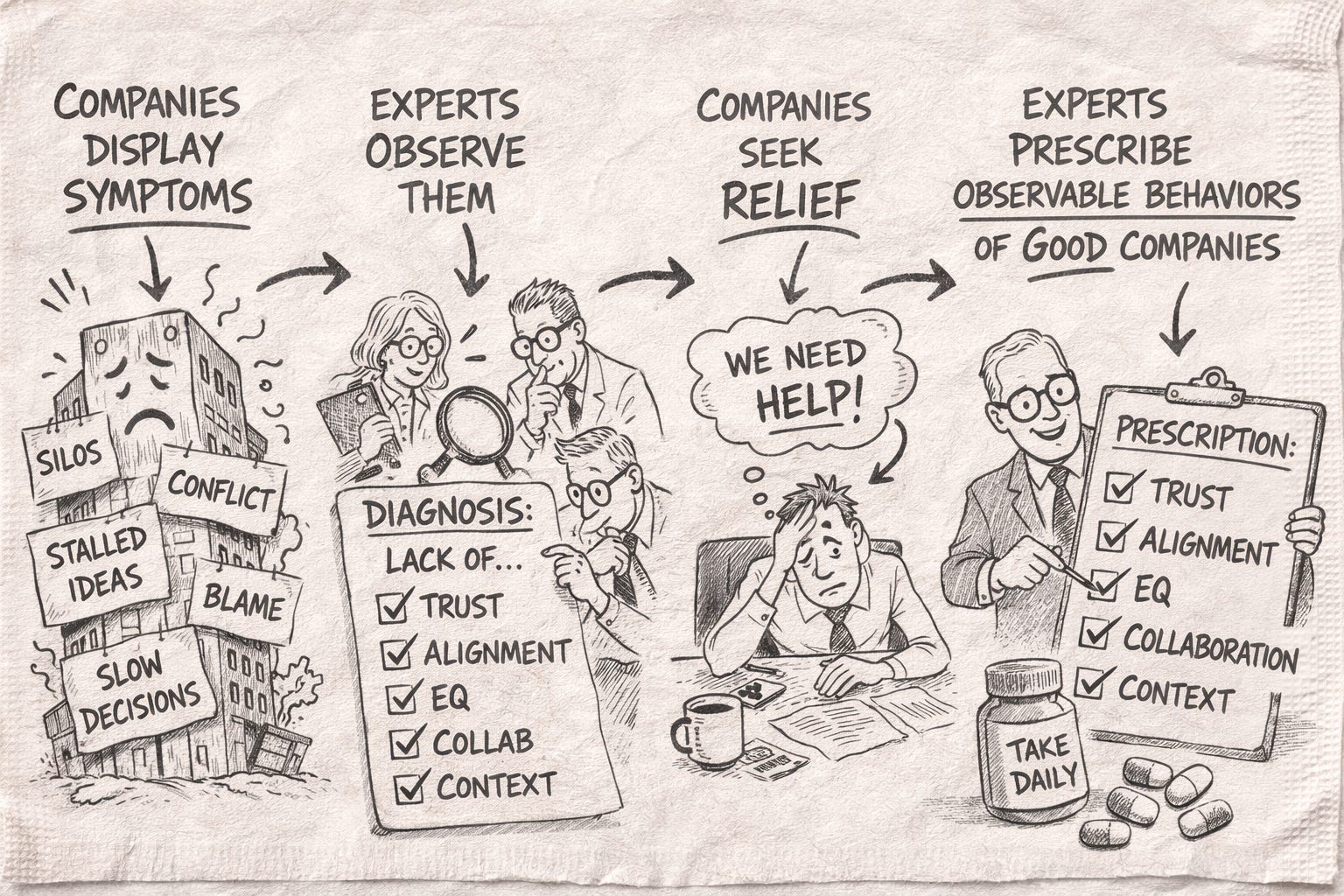
Companies display symptoms
↓
experts observe them
↓
companies seek relief
↓
experts prescribe observable behaviors of good companies.
Explanation ≠ Prediction
Maybe the prescriptions aren’t dealing directly with the cause of the headache.
The hammer.
The Hammer
Innovation doesn’t fail because organizations lack “bridgers.”
Innovation fails…
because DECISIONS inside organizations
are governed by playbooks of OPINION LAND
(offense and defense)
rather than structured
PROBLEM SOLVING and DECISION LOGIC
But if we are using best practices, how can I say that we’re not using good problem solving and decision logic?
Innovation fails when decisions are governed by Opinion Land. I know, I was there.
In the mid-2000’s I represented my company at the Innovation Round Table. These were the large and cutting edge companies of northern Europe who spoke at conferences. They had collaborations with thought leaders like Clayton Christensen (Disruption!), Henry Chesbrough (Open Innovation!), Tim Brown (Design Thinking!), Jane McGonigal (Gamification!). They had wins to point at. Even the Lego Group turned its struggling toy business around by expanding the brand into storytelling and entertainment. (Movies!) Yeah man, this was cool!
Until you talked to innovation leaders privately.
Behind the scenes the story was very different. Not 100% of the time, but often enough to notice a pattern: good ideas were there, corporations kill good ideas, politics and power struggles dominate how things get done, and it makes no sense. Innovation leaders were frustrated!
Then 20 minutes later you’d see the same person, on stage, talking about how amazing their innovation program was.
Innovation fails for the same reason working in Opinion Land sucks: innovation is about what’s new, that’s risky, and that’s a threat. Opinion Land leaders are conditioned to eliminate threats. They’re leaders because they’re good at it.
So what’s the actual hammer? Our cognitive pre-sets.
Individual Hard wiring. We don’t know what we think we know. Those pre-sets drive the threat reflexes that emerge within a culture of confusion. It’s the power dynamics of the status game. That’s Opinion Land. It sucks.
Innovation is difficult because the human nervous system is designed to avoid destabilization — and innovation is destabilization.
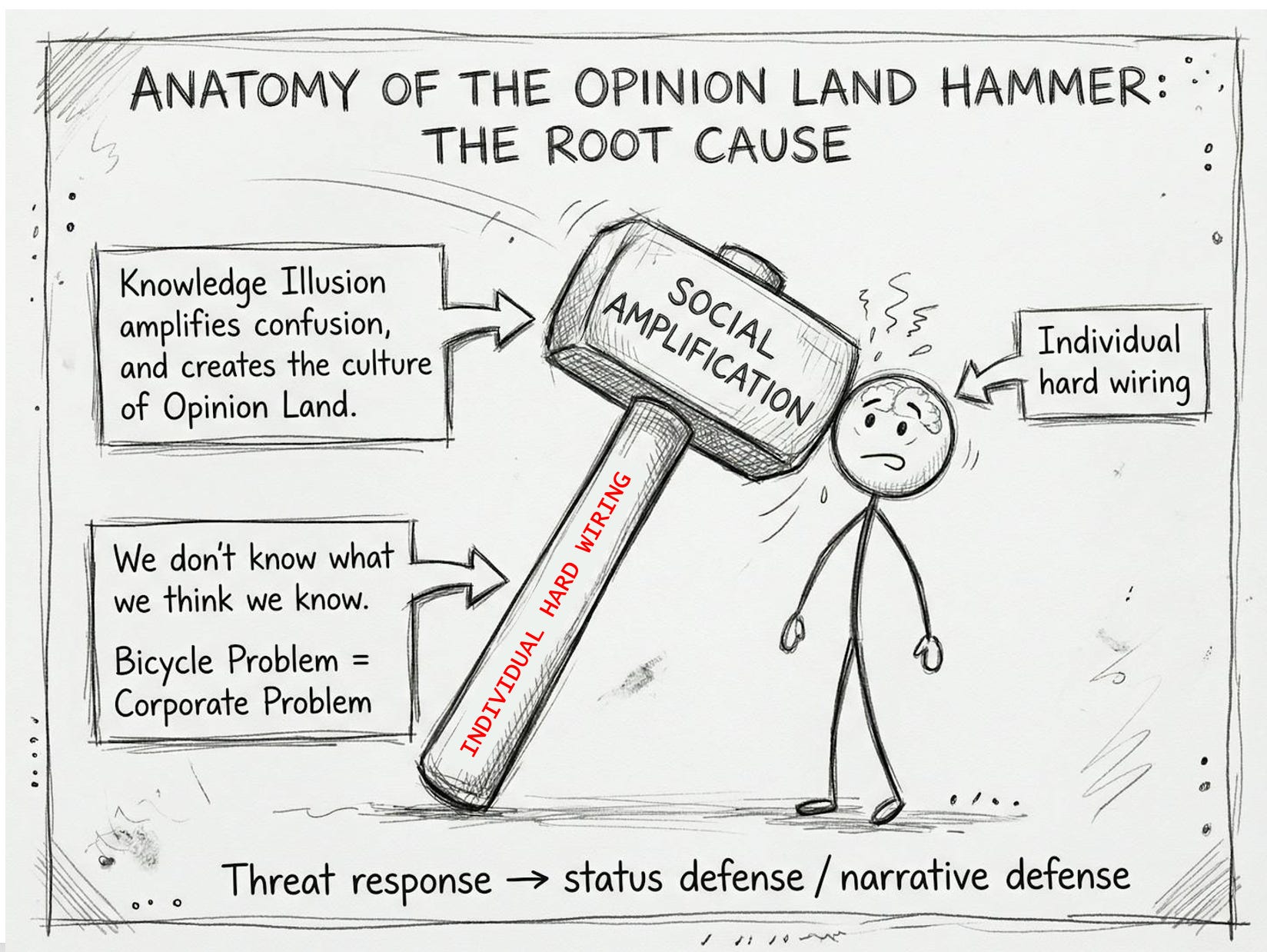
This dynamic is embodied. It’s why I call it the Human Embodiment Problem.
“Give it up already! This is human nature, you can’t do anything about it.”
I disagree.
FIRST - THE OLD LOGIC WON’T WORK, so lets stop assuming the expert prescriptions – more of the same – will give us the sustainable relief we’re looking for, i.e., Same failed strategy will give a different result. That’s a definition of crazy. That’s why I decoded the HBR article.
Explanatory solutions framed as best practices are cool, they feel right, but treating symptoms ≠ relief.
SECOND - THE NEW LOGIC MUST TIE TO PHYSIOLOGY, so lets strip out the word “culture”, that’s a consequence of collective behavior. The collective behavior is a roll up individual and team behavior.
Predictive solutions framed as the work of developing human capacity for structured responses to high pressure conditions = relief.
But there’s a learning curve.
Summarizing this post: decoding patterns we see.
Innovation introduces instability.
Human physiology is wired to defend stability.
That tension explains innovation and transformation failures.
The next post: the answer for the hammer problem.
How do we intervene on an ancient physiological reflex to avoid destabilization? How do organizations do that? It’s simple, actionable, and has a LOT of precedence. Coach #3 points the way.
Stay tuned.
Game On.